Pad geometry vs. rotor shadow: how satellite imagery actually finds a turbine
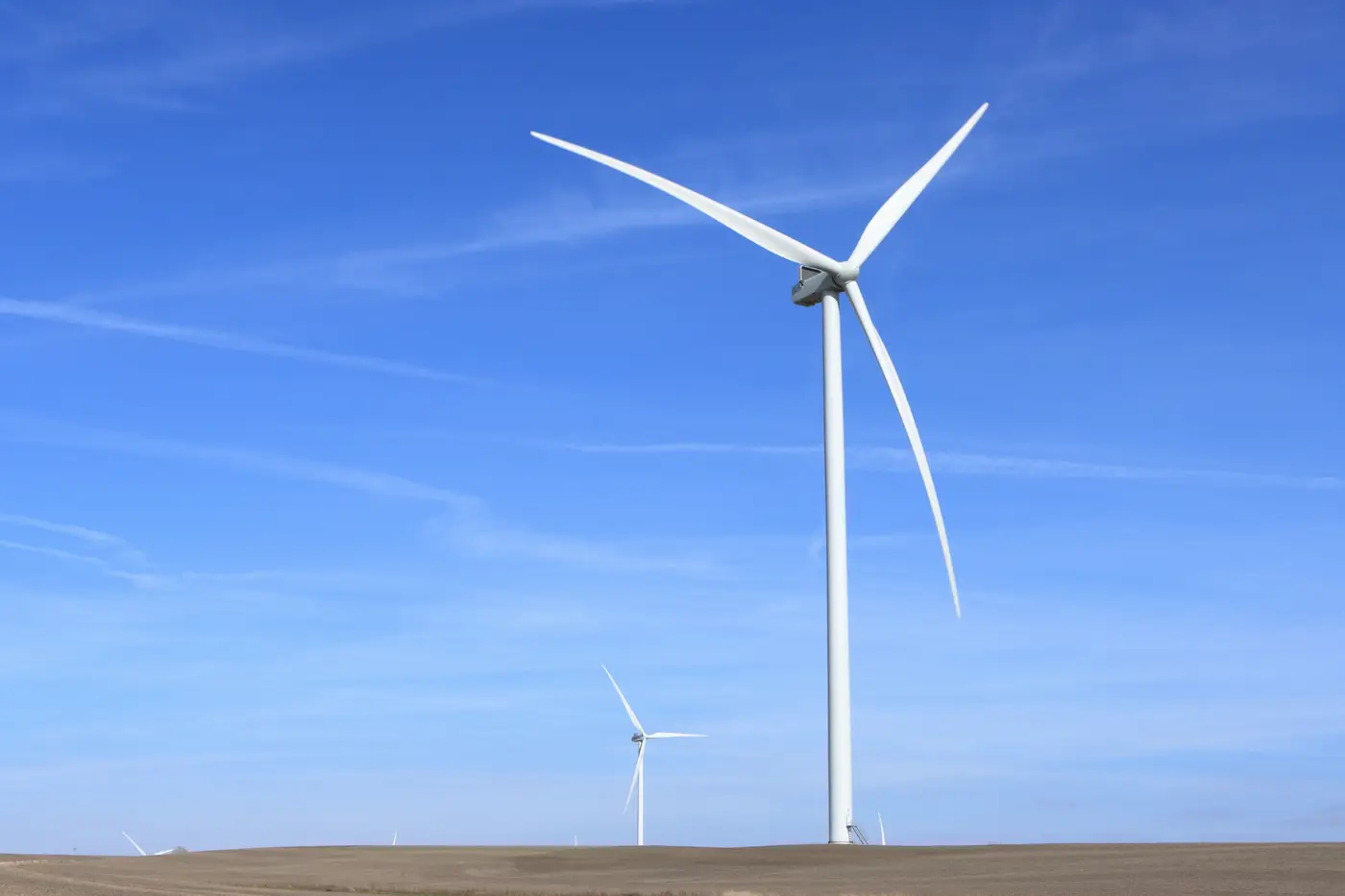
If you've ever tried to digitize a wind farm off basemap imagery, you've probably noticed that turbines don't look the same from one image to the next. Sometimes you're tracing a long dark streak across the ground. Sometimes there's no streak at all and the only thing giving the turbine away is a pale circle or cross where the crane pad and access road meet the tower base. These are two different signatures, and knowing which one you're looking at changes how reliable your count is.
The rotor shadow: strong signal, bad attendance record
A rotor shadow is exactly what it sounds like: the blades cast a long, thin shadow across the ground, and at the right sun angle it's one of the most visible things in the whole scene. Three blades sweeping a 120+ meter diameter throw a shadow that can stretch well past the tower itself, which makes it easy to spot even at moderate resolution.
The catch is that the shadow only shows up under the right conditions. Low sun angle, clear sky, and a rotor orientation that happens to cast the shadow somewhere unobstructed. Midday imagery over a wind farm in summer can show almost no shadow at all, because the sun is nearly overhead and the shadow collapses to almost nothing under the nacelle. A turbine sitting in the lee of a ridge, or one where the blades happen to be feathered and nearly edge-on to the sun, can disappear from a shadow-based count entirely even though it's spinning right there on the horizon.
So a detection method built only on shadow is going to miss turbines depending on the time of day the image was captured, the season, and even which way the rotor happened to be pointed when the satellite passed over. For a single snapshot that's a real gap, not a rounding error.
Foundation pad signature: the part that doesn't move
The foundation pad, the compacted gravel or concrete working area around the base, plus the access spur connecting it to the farm's road network, is a different kind of signature. It's there in every pass, regardless of sun angle, blade position, or season, because it's a ground disturbance, not a shadow. Pad geometry tends to show a consistent footprint: a cleared circular or oval area sized to the crane and construction equipment, usually with a short spur road running off it at an angle that lines up with the turbine string.
That consistency is what makes pad geometry the more dependable half of the pair. It won't vanish because the sun was high. But it has its own blind spot: a bare patch of gravel can look a lot like plenty of other things on a working landscape, staging areas, substations, borrow pits, old drill pads. Pad geometry alone, without something confirming there's a tower and rotor actually sitting on it, risks counting infrastructure that isn't a turbine at all, or missing a turbine where vegetation or snow has partly reclaimed the pad since construction.
Running both together is what actually resolves a hub
Neither signature on its own gives a trustworthy fleet count. The rotor shadow confirms there's a spinning machine, but only when conditions cooperate. The pad confirms there's turbine-scale ground disturbance, but only when it's paired with something that rules out false positives. Running detection against both, and resolving the two against each other, is what lets a point get assigned a hub coordinate with confidence rather than a guess based on one imperfect clue.
That's the approach behind the quarterly turbine point layer we build for siting and wake-loss work: shadow and pad geometry cross-checked against each other, so a candidate or competitor site's fleet map doesn't depend on catching every turbine at the one moment its shadow happens to fall where the satellite can see it.
If you're scoping turbine density on a site and don't want to wait on an operator's next disclosure cycle, that's exactly what Wind Turbine Mapping is built to hand you.